Richard William Hubbard (1816-1888)

Richard W. Hubbard was born in Middletown, CT, in 1816. His mother died when he was a child, and he was raised by his father, a cashier at the Middletown Bank. After graduating from Middletown Academy in 1837, Hubbard entered Yale College but soon left to pursue art. In 1838 he moved to New York and enrolled in the antique class at the National Academy of Design, where he sought instruction from Samuel F. B. Morse. Hubbard initially intended to study portrait painting, but in 1840 he went abroad, spending two years in England and France. His European studies, including exposure to the landscapes of Claude Lorrain, influenced his developing interest in landscape painting. After returning to the United States, he continued his studies under Daniel Huntington.

By 1850 Hubbard had established a studio in the New York University building, where he remained until moving to the Tenth Street Studio Building in 1859. He maintained a studio there for the rest of his life. Hubbard traveled extensively in search of subjects to paint, particularly along the Hudson River Valley and in Vermont, Connecticut, and New Hampshire. Hubbard’s landscapes first appeared in an annual exhibition at the National Academy of Design in 1842, and he thereafter exhibited regularly at the Academy. He served as a juror in 1855 and 1856 and on the Academy’s Council from 1861 to 1862. In 1859 he was a founding member of the Artists’ Fund Society, and in 1873 he was elected president of the Brooklyn Art Association, a position he held for nine years. He was also a member of the Century Association.

Hubbard reportedly made a sketching trip through the White Mountains of New Hampshire while en route to the coastal regions of Maine during July of 1850. He traveled in the company of fellow artists Frederic Church and Régis F. Gignoux. Letters published in the Bulletin of the American Art-Union and attributed to Church place the artists along a route through Littleton, Bethlehem, Fabyan’s, Crawford Notch, Franconia Notch, Plymouth, and Wolfeboro. The account indicates that they made no oil paintings in the field during this portion of the journey, but instead produced numerous pencil sketches of subjects that attracted their attention.

In an 1854 scene recorded by Sanford Gifford in his sketchbook, Hubbard was shown at Conway Center, New Hampshire, sketching with Benjamin Champney, Miss Bangs, and Alfred Ordway. The Crayon for December 1856 noted that “Mr. Hubbard has … made a study of the ‘Stepping-Stones,'” a favorite Conway subject that had also been recorded by Daniel Huntington.

Richard William Hubbard died at his home at 121 St. James Place in Brooklyn on December 21, 1888. His funeral was held at his residence on the afternoon of December 24, with members of the National Academy of Design invited to attend. Hubbard was buried in Green-Wood Cemetery, Brooklyn, NY.

Following Hubbard’s death, sixty-seven paintings and oil studies from his estate were offered at auction, together with twenty paintings contributed by members of the Artists’ Fund and the Artists’ Mutual Aid Society, of which Hubbard had been a member. The sale was held at the Fifth Avenue Art Galleries in New York City for the benefit of the societies. Several of the Hubbard paintings offered were of New Hampshire subjects, including: Moat Mountain ($15.00), White Mountains, Lower Range ($27.00), Mount Lafayette ($15.00), and First Snow on Mt. Adams ($15.00).

Obituary From Times Union
Brooklyn, NY / Monday, December 24, 1888 / Page 1 / Obituary.

Richard W. Hubbard, one of America’s best known landscape painters, died suddenly at his residence at 121 St. James’ Place, this city, on Friday night, aged 72 years. He was a bachelor, a graduate of Middletown Academy and Yale College, afterwards visited Europe, and came back to study portrait painting under Daniel Huntington. He soon left it and took up landscape painting, in which be became famous. He was many years president of the Brooklyn Art Association.

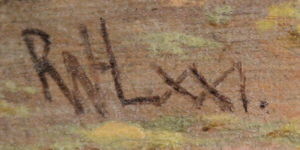
Signature

References
"Chronicles of Facts and Opinions: American Art and Artists," Bulletin of the American Art-Union (November 1850)
Independent research by the authors
National Academy of Design - Richard William Hubbard (1816-1888)
New Hampshire Scenery