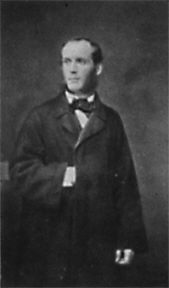
Frederic Edwin Church was born in Hartford, CT, on May 4, 1826. He developed an early fondness for art and in 1844, at the age of eighteen, became the only pupil of Thomas Cole at Catskill, NY. He was soon proficient enough to begin exhibiting his work, and among his first notable subjects were views in the Catskill Mountains. He was elected an associate member of the National Academy of Design in 1849 and a full member the following year. In 1850 he was also elected a member of the Century Association.
Church traveled extensively in search of material for his paintings, journeying from the Arctic to the tropics and making copious sketches. He ventured to South America in 1853 and again in 1857, and in 1868 traveled to Europe and the Holy Land. His travels provided material for paintings that brought him a national and international reputation. His large canvases were noted for their realistic detail and technical virtuosity, and during his most successful years his work commanded prices higher than those previously paid for paintings by American artists.
Church reportedly made several sketching trips through the White Mountains of New Hampshire while en route to the coastal regions of Maine. One such journey took place in July 1850, when he traveled in the company of fellow artists Richard W. Hubbard and Régis F. Gignoux. Letters published in the Bulletin of the American Art-Union and attributed to Church place the artists along a route through Littleton, Bethlehem, Fabyan’s, Crawford Notch, Franconia Notch, Plymouth, and Wolfeboro. The account indicates that they made no oil paintings in the field during this portion of the trip, but instead produced numerous pencil sketches of subjects that attracted their attention. Church was particularly impressed by the mountain scenery encountered on the journey south from the White Mountains between Franconia Notch and Plymouth. Writing of the landscape, he observed:
“We have neither of us painted anything yet. It would be impossible to do it among the mountains, infested as they are by mosquitoes and flies; but we have made a dozen or more careful sketches in pencil, of more or less value. The ride thence to Plymouth is through the richest-looking country ever I saw, judging from the luxuriance of the vegetation. In regard to scenery, about seven miles the other side of Plymouth, on looking behind us, we beheld a view which, for amplitude and richness of feature, I think I never yet saw equaled”.
Church’s 1857 painting of Niagara Falls established his high rank among landscape artists, and the work was awarded a second-class medal at the Paris Exposition of 1867. It was subsequently sold at the John Taylor Johnston sale in New York in 1876 for $12,500 to the Corcoran Gallery in Washington, DC. His work was also exhibited in England, where his reputation had become well established.
Church maintained a studio in the 10th Street Studio Building in New York City from 1858 to 1887. He was a founding trustee of the Metropolitan Museum of Art and served with the institution from 1870 to 1887.
In 1876 Church suffered his first attack of what was described as “inflammatory rheumatism,” which eventually led him to paint with his left hand. His health had been impaired by the disease for many years, and he spent twelve successive winters in Mexico, where he found a climate suited to his health. By 1880 his painting activity had declined markedly, and he increasingly devoted himself to the embellishment of his home, Olana, on the hills above the Hudson River opposite Catskill. He designed and built the estate, which became his principal home for many years. Olana also became a gathering place for prominent literary and artistic figures from the United States and abroad. Among Church’s regular guests were Samuel L. Clemens and Charles Dudley Warner.
Church’s reputation as a landscape painter remained considerable. Following his death, J. Carroll Beckwith of the National Academy of Design described him as one of the most distinguished painters of the American landscape school, noting the distinction of his composition and choice of subject, together with phenomenal skill and great care in the observation of nature. An intimate friend of the family similarly observed that no artist had studied nature in so many different parts of the world or under such varied aspects as Church. His subjects ranged from the icebergs of the northern ocean to Niagara Falls, the snow-covered peaks and tropical forests of South America, and the ancient landscapes and monuments of Europe.
Church died on April 7, 1900, at the home of his lifelong friend William H. Osborn at 32 Park Avenue in New York City. He had returned only the previous week from Mexico. He was survived by three sons and a daughter; his wife had died the previous year. Following funeral services in New York, his body was brought to Hartford, where the commitment service was conducted at the grave in Spring Grove Cemetery. He was buried beside his wife.
Obituary From San Francisco Chronicle
San Francisco, CA / Monday, April 9, 1900 / Page 3 / DEATH OF A SCENIC PAINTER. / Frederic Edwin Church Expires in New York.
NEW YORK, April 8. — Frederic Edwin Church, the celebrated scenic painter, is dead. The interment will be at Hartford, Conn.
Frederic E. Church was born at Hartford, May 4, 1826 and early displayed great artistic ability, becoming an academician of the National Academy of Design when only 23 years old. His painting of Niagara Falls, now in the Corcoran Gallery at Washington, received a medal at the Paris exposition of 1867. He should not be confused with Frederick Stuart Church, the painter of animals.
Images of Frederic Edwin Church
- Frederic Edwin Church (1826-1900)
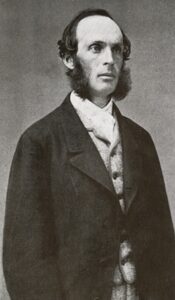
- Frederic Edwin Church (1826-1890)
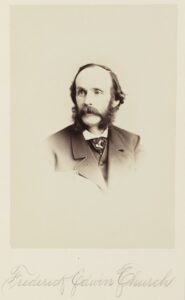
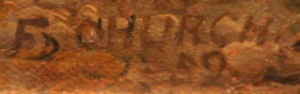
Signatures
- 1852
- 1855
- 1856
Reference
"Chronicles of Facts and Opinions: American Art and Artists," Bulletin of the American Art-Union (November 1850)
Independent research by the authors
New Hampshire Scenery