Nicknamed “Claude” Brown for the French landscape painter, Claude Lorraine, whom he admired, Brown was among the most celebrated of American painters living abroad in the 19th century. He was born in Boston, MA, on February 2, 1814, the third of eight children of Loring and Joanna Pratt Brown. As a teenager, Brown began working as an apprentice wood engraver with Alonzo Hartwell and soon took up painting. He forged a relationship with Isaac P. Davis, a member of the Fine Arts Committee of the Boston Anthenaeum, and in 1832 he exhibited six paintings as part of the organization’s sixth exhibition.
Bolstered by his early success, Brown set out for Antwerp, Belgium, in July of 1832. While traveling through Europe, he received further training from Eugene Isabey in Paris, France. Isabey was known for his loose brushwork, heavy impasto and dramatic skies, which made a lasting impact upon the burgeoning American artist. While in France, Brown was also exposed to the works of Ruisdael Constable and Claude Lorrain at the Louvre. He became competent at making copies of these paintings, which were sent back to Boston to be sold.
On his return to Boston in the fall of 1834, Brown began working as an artist and illustrator. In order to make ends meet financially, he painted portraits, miniatures, and oil paintings intended for reproduction in novels and song books. Although busy with various artistic endeavors during this period, his true calling was with landscape painting and in producing sketches from nature. In 1839, the aging Washington Allston encouraged Brown to return to Europe for more study, which likely provided inspiration for his trip abroad the following year.
In July of 1840, a sale was organized to liquidate the contents of his studio. By the following month, he and his first wife, Harriet Pease Brown, set sail aboard the Louis Philippe to Europe. The couple settled in Rome, Italy, where Brown won the favor of traveling businessman, George Tiffany, of Baltimore, MD. Tiffany, the first cousin of jeweler Charles Tiffany, was so enamored by Brown’s potential that he provided the artist with $1,000 “to be invested according to his own taste in the fruits of his expressive pencil.” This fortuitous encounter afforded Brown the necessary resources to refine his artistic skill set and develop techniques which later provided him a comfortable living through the sale of Italian landscape paintings to both American and European tourists.
In 1859, Brown returned to the United States and maintained a studio at 756 Broadway in New York City during the period 1861 to 1862. During the 1860s and 1870s, he made many sketching trips to the White Mountains and often inscribed his canvases verso with the locations of his works. He was very fond of the Jackson area, as well as New Hampshire’s Pemigewasset River Valley. In 1875, Brown painted extensively in and around Campton, NH, with a student, Willard Leroy Metcalf, who later emerged as a successful artist of considerable merit. Landscape artist and illustrator, J. Warren Thyng, was also a student who benefited from Brown’s tutelage. Perhaps Brown’s greatest New Hampshire painting was The Crown of New England, a huge panoramic view of Mount Washington, which was purchased by the Prince of Wales in 1861. Although now unlocated, a smaller version is housed in the collection of the Hood Museum of Art at Dartmouth College.
Brown spent the summer season of 1878 painting in Jackson, NH, and by the spring of 1879, he was preparing for a return to Europe to revisit the locations of his earlier studies. An exhibition and auction of 333 oil paintings and water color drawings was organized by Doll and Richards on May 7,8, 9, and 10, of that year. With his Boston studio cleared, in January of 1880, Brown, along with his third wife, Julia P. Brown, and pupil, Thaddeus Defrees, traveled to Europe. On January 24, they departed from the Port of Boston aboard the Cunard Line S/S Samaria, en route to Liverpool, England. The trip was expected to last several years. However, after having spent just a few months abroad, Brown was forced to return back to Boston on account of his wife’s declining health.
Brown’s illustrious career lasted nearly six decades. He exhibited at the Boston Athenaeum (1832-1873), the Boston Art Club (1875-1882), the Brooklyn Art Association, the Pennsylvania Academy of Fine Arts, and the National Academy of Design (1837-1885). He primarily painted Italian scenes in later life, responding to the public’s preference for his European views, but occasionally painted American scenes as commissioned works.
By the late 1880s, Brown’s health had deteriorated significantly. He suffered a stroke in 1887 and another in 1888. He continued to paint from his second story home studio, but he died on June 25, 1889 at the age of 75. A funeral was held in his Malden, MA, home three days later, and following these services, Brown was laid to rest at Evergreen Cemetery in Kingston, MA.
Obituary From Hartford Courant
Hartford, CT / Friday, June 28, 1889 / Page 1 / George Loring Brown.
George Loring Brown, one of the noted landscape painters of the country, died at his home in Malden, Mass., on Tuesday, at the age of 75. When a mere boy he went to Europe on $100 of borrowed money, but managed to make friends and succeed in spending two years in study. He went back to Boston and became the pupil of Washington Allston. At the age of 24 he went abroad again, studied first under Eugene Isaberg at Paris, and then spent twenty years in Antwerp, Rome, Florence, Paris and London. Then he came back to America to live. He continued actively at work until the end of his life.
Images of George Loring Brown
-
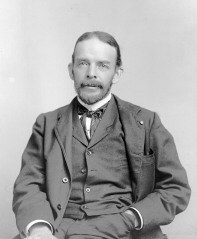
- George Loring Brown (1814-1889)
-
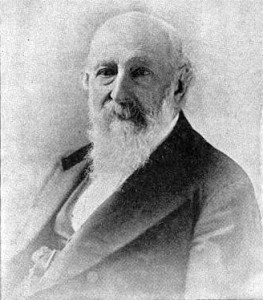
- George Loring Brown (1814-1889)
Gravestone
-
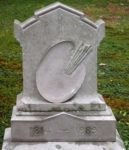
- George Loring Brown Gravestone, Kingston, MA
-

- Closeup of George Loring Brown Gravestone, Kingston, MA
Typical Verso Inscription
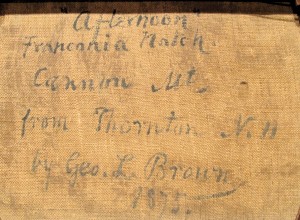
Afternoon / Franconia Notch / Cannon Mt. / from Thornton N.H / by Geo. L. Brown / 1875
Signatures
-

- 1860
-

- 1863
-

- 1869
-

- 1875
-

- 1877
-
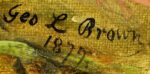
- 1877
References
Diary of an Artist's Wife: Mrs. George Loring Brown in Italy, 1840-1841
George Loring Brown - Landscapes of Europe and America 1834-1880
Independent research by the authors
New Hampshire Scenery