Joseph Warren Thyng was a landscape painter and author who was born August 3, 1841 in Lakeport, NH. He also lived in Salem, MA, Manchester, NH, Plymouth, NH and Akron, OH. For the last six years of his life, he maintained a studio in North Woodstock, NH, where he continued a lengthy association with artist Mary L. Foster.
Thyng produced pen and ink sketches, and painted in both oils and watercolors. He studied under George Loring Brown in Boston, received instruction from Frederic Church, George Inness and William Hart and studied classical art at the National Academy of Design in NY.
In 1865, J. Warren Thyng married Sara Elizabeth Babbidge in Salem, MA and published Salem Witch the following year. The couple had a child, Mabel Warren Thyng, who also demonstrated artistic ability at an early age. In 1893, as a eight year old, Mable’s submission of a sketch to the Philadelphia Centennial Exhibition was touted by the New York Tribune as being from the youngest exhibitor from any part of the world. In homage to his daughter, the elder Thyng would sometimes include the name “Mabel” on the side of boats depicted in his various paintings.
In 1871, Thyng was part of a group credited with renaming certain bodies of water in the vicinity of Lake Winnipesaukee, which he documented in the Lake Village Times. Long Bay, between Lakeport and Weirs Beach, was changed to Paugus Bay in honor of Chief Paugus, who fought in the Battle of Pequawket. Laconia’s Round Bay was renamed Lake Opeechee, the Native American name for robins, which flocked to its shores each spring. Additionally, the name Long Pond was changed to Lake Winona, having originated from a legend about a Native American princess of the same name. Thyng was very knowledgeable about the area and in 1882, wrote an illustrated guidebook of New Hampshire’s Lakes Region, Lake-country Sketches; Legends and Pictures of New Hampshire Lakes and Mountains with his student artist, Sabra Cather.
Thyng was an instructor at the Massachusetts State Normal Art School in Salem, MA for eleven years. He also taught in New Hampshire at the Manchester public schools, and the normal school in Plymouth. Throughout his professional career, Thyng remained active in educational clubs and academic activities. He was a noted lecturer and served the New Hampshire Teachers’ Association as both Chairman and President of their Drawing Section Committee.
He moved to Akron, OH in 1883, and was a founder of the Akron School of Design. He remained in Ohio for eight years, and served concurrently as the supervisor of drawing in the public schools for six of those years. He later worked for the Manchester Union, the Boston Globe and acted as a special artist for Harper’s Weekly for 12 years. In 1908, he wrote Reminiscences of the Poet Whittier in conjunction with illustrator Clinton H. Cheney. In 1926, he illustrated The Franconian Gateway and Region of Lost River with author G. Waldo Browne.
His works are represented at the New Hampshire Historical Society.
Some known paintings include:
Lake Winnipesaukee Showing the Excursion Steamer. Aquatint. 12 ¾ x 16 ¾ inches.
Mount Washington Steamer – A Side Wheeler. Oil on canvas. 1869.
Mt. Chocorua and Lake, New Hampshire. Morning Early Autumn Oil on board 14 x 12 inches.
Valley of the Pemigewasset. Oil on canvas. 1901. 37 x 56 ¼ inches.
J. Warren Thyng died of bronchial pneumonia (complicated by edema of the lungs) in North Woodstock, NH on July 9, 1927. Funeral arrangements were handled by H. G. Kinne of North Woodstock. He was interred on July 12, 1927, in Hillside Cemetery, Laconia (Lakeport), NH.
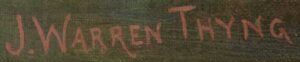
Signature
Images of Professor J. Warren Thyng
-
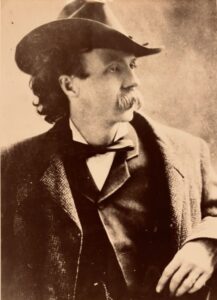
- Professor J. Warren Thyng (1841-1927)
-
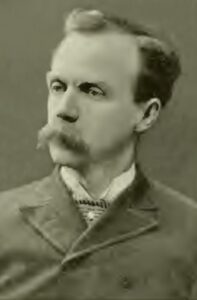
- Professor J. Warren Thyng (1841-1927)
-
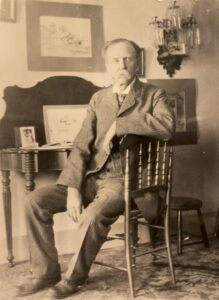
- Professor J. Warren Thyng (1841-1927)
-
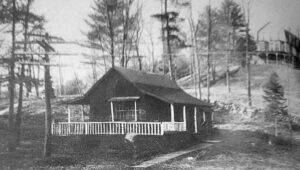
- Studio of J. Warren Thyng and Mary Foster in North Woodstock with Mountain View House in Upper Right Background
Image Credits (Left)
Courtesy of Thyng's great, great granddaughter, Melanie Christon
References
Independent research by the authors
New Hampshire Scenery