John Austin Sands Monks was born on November 7, 1849, in Cold Spring, a small village on the Hudson River in New York. As a teenager, Monks demonstrated considerable artistic ability as a wood carver. At the age of 18, he moved to Connecticut to become an apprentice engraver.
The following year, in 1869, Monks moved to Massachusetts where he established himself in the etching business. He soon developed a relationship with George Cass, a student of landscape artist George Inness. In due time, Monks too became a student of Inness. A Boston Evening Transcript newspaper article from June 1, 1875 documented the artists travelling together in the White Mountains. “George Inness and son, and John A. Monks are at the Kearsarge House, North Conway, sketching in the vicinity.”
In 1877, Monks married Olive Betsy Young of Medfield, MA. In March of that year, he exhibited a painting titled Mt. Washington at the Appalachian Mountain Club Exhibition. Early in his career, Monks introduced sheep as accessory figures within landscape compositions. Over time, his interest in the animals themselves deepened, and the landscape gradually became subordinate. Monks pursued his subject with unusual seriousness and isolation. He spent long periods studying sheep in remote locations, including Cuttyhunk Island off the Massachusetts coast, and for a time lived among shepherds in the Alps.
Professionally, Monks was a member of the Boston Art Club, the Copley Society and the New York Etching Club. He maintained a studio in New York City between 1884 and 1885. In 1886, he established a Boston studio at 294 Boylston Street. He exhibited five paintings at the Newton Club from December 9th to December 17th, 1896, including: Corner of Yard – November ($175), Dawn ($125), Bit of Venice ($50), Venetian Boats ($50), and Broadway, England ($65). His output of work was extensive, and visitors to his Boston studio in December 1916 reported viewing “several hundred canvases and studies,” representing the accumulation of many years of focused labor.
During the winter of 1916-1917, arrangements were completed for a solo exhibition at the Swain Galleries in New Bedford, MA. Monks continued to produce new etchings specifically for that showing. It was during this period that Monks became ill, and, acting on medical advice, prepared to travel to California in hopes of restoring his health. While enroute to the Golden Sate Monks stopped in Chicago, IL to visit family and stayed at the home of his sister. On the evening of March 13, 1917, Monks was actively engaged in completing etchings intended for his upcoming exhibition when he suffered a stroke of paralysis. He died in Chicago on March 14, 1917 and was subsequently buried at Vine Lake Cemetery in Medfield, MA.
Following his death, the exhibition at the Swain Galleries proceeded as planned. It included thirty one paintings and etchings, among them works completed only days before his passing. Writing in the exhibition catalog, contemporaries emphasized Monks’ lifelong devotion to his art, his willingness to make personal sacrifices in pursuit of excellence, and the sincerity that characterized both his work and his character. A Boston Post newspaper article from March 17, 1917 reflected on his legacy, stating “Monks made the painting of sheep his chief life work and in that genre he was unapproached by any other artist in America.”
Images of John Austin Sands Monks
-
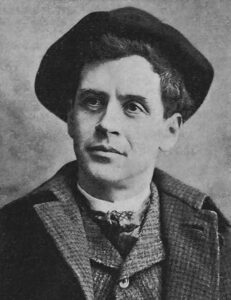
- John Austin Sands Monks (1849-1917)
-
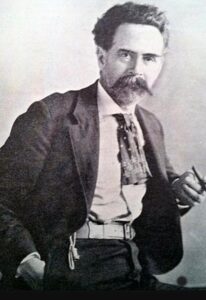
- John Austin Sands Monks (1849-1917)
Gravestones of John Austin Sands Monks
-
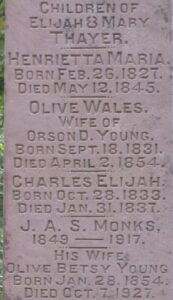
- Gravestone of John Austin Sands Monks, Vine Lake Cemetary, Medfield, MA
-
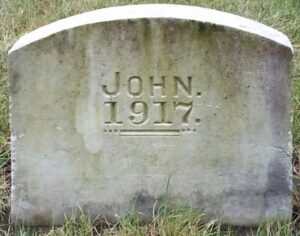
- Gravestone of John Austin Sands Monks, Vine Lake Cemetary, Medfield, MA
References
Catalog titled “Appalachian Mountain Club, Paintings and Sketches, Exhibited March 14, 1877.”
Independent research by the authors
Independent research by Charles Vogel and Allen Vogel
Medfield Massachusetts Historical Society