Asher Brown Durand, the son of a watchmaker and silversmith, served a five-year apprenticeship to an engraver, Peter Maverick, in Newark New Jersey. After completing his apprenticeship, he became a partner in the business. His reputation as an engraver was firmly established with the publication of his engraving after John Trumbull’s Declaration of Independence in 1823. Between 1821 and 1831 Durand helped found the New York Drawing Association (1825), the National Academy of Design (1826), and the Sketch Club (1827). Also during this period, he formed a partnership with his brother, Cyrus, and Charles C. Wright which specialized in the production of bank notes.
In 1832 Durand dissolved his profitable engraving business and entered into a short, successful period as a portrait painter. A financial panic in 1837 combined with encouragement from Thomas Cole led him to try landscape painting. He became the second president of the National Academy of Design in 1845, a position he held until his resignation in 1861. In 1847 the artist helped found the Century Association.
In 1855, Durand published a series of nine instructional essays entitled Letters on Landscape Painting in The Crayon, an influential art journal co-edited by his son, John Durand. Addressed to aspiring artists, the letters emphasized direct observation of nature, outdoor sketching, and the accurate representation of natural forms. Durand advised, “Yes! go first to Nature to learn to paint landscape,” encouraging artists to study trees, rocks, foliage, and other landscape features before incorporating them into larger studio compositions. His writings helped establish principles of landscape painting that influenced the techniques and working methods of American artists throughout the nineteenth century. Emphasizing the importance of careful observation and faithful execution, Durand further instructed artists to “Paint and repaint until you are sure the work represents the model—not that it merely resembles it.”
Durand visited the White Mountains as early as 1839, and again from 1855 to 1857. The Crayon for November 1856 noted, “Mr. Durand’s sketches of West Campton scenery, … are both larger and of a different character than his previous studies, being almost wholly confined to mountain views.” A notable example of his finished work from this period is a rendering of Franconia Notch and the Pemigewasset River from School House Hill in West Campton.
The painting of Durand on this page was painted by Daniel Huntington in 1857 based on a trip to Franconia Notch in 1855 where Huntington accompanied Durand (see the Reference below).
Durand spent the rest of his life after 1857 painting in New York City. He died on September 17, 1886 and is buried in Green-Wood Cemetery, Brooklyn, New York.
Obituary From The San Francisco Examiner
San Francisco, CA / Sunday, September 19, 1886 / Page 8 / A NATIVE PAINTER. / Death of Asher B. Durand. / President of the Academy of Design.
NEW YORK, September 18. — Asher B. Durand, perhaps the oldest American painter of note, died yesterday at his home in South Orange, N. J. He was born in 1796 at Jefferson, N. J. His first noticeable work was the engraving of Trumbull’s “Declaration of Independence.” In 1835 he abandoned the gravure for the brush, having before this become a frequent contributor of portraits and landscapes in oil to the National Academy of Design exhibition. At first he devoted himself to portraits and figure subjects, but turned his attention to landscape painting in later years, and for this he is chiefly known. His rendering of mountain scenery especially is much admired, and he counted among his best works “Franconia Mountain,” “A Primeval Forest,” and “The Rainbow.” In 1854 his portrait of William C. Bryant, afterwards engraved by himself, was painted, while among his historical subjects are “The Capture of Major Andre,” and the “Wrath of Peter Stuyvesant.” Durand was elected President of the National Academy of Design at the death of Professor Morse, and this honorable position he held for many years.
Images of Asher Brown Durand
-
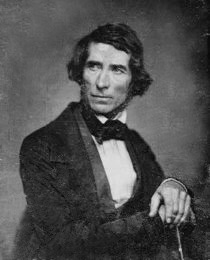
- Asher B. Durand (1796-1886)
-
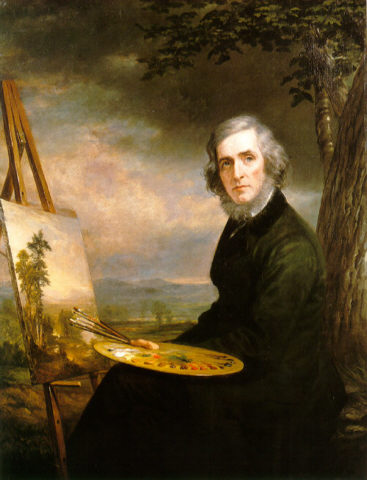
- Portrait of Asher B. Durand (painting near Franconia Notch, 1855) by Daniel Huntington
-
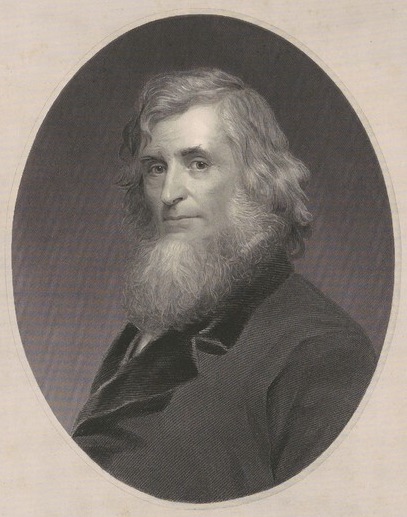
- Asher B. Durand (1796-1886) Engraving from 1865
-
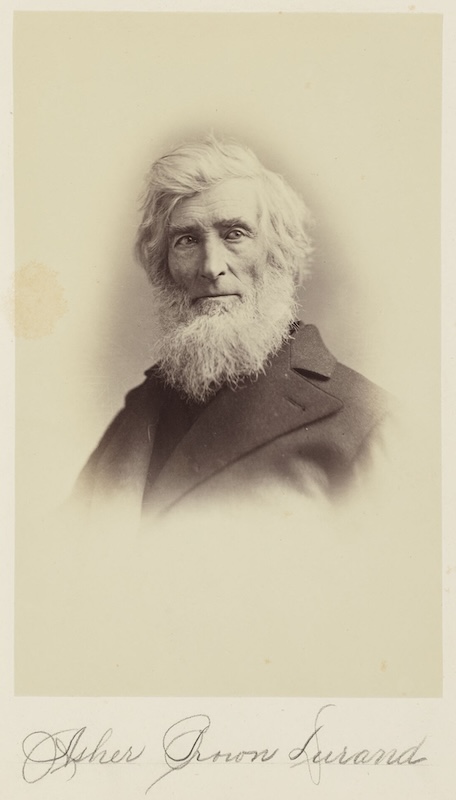
- Asher Brown Durand (1796-1886) photo from 1867
Signatures
-

- 1845
-
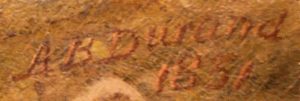
- 1851
-
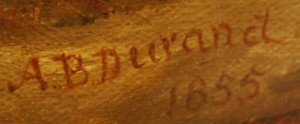
- 1855
-
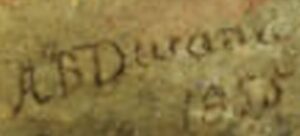
- 1855
-
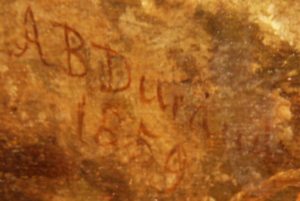
- 1859
-
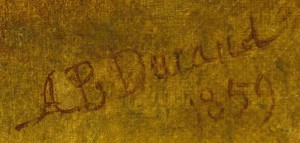
- 1859
-
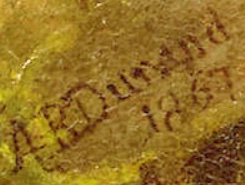
- 1867
Top Left: Courtesy of Charles O. Vogel
References
Independent research by the authors
New Hampshire Scenery
The Painted Sketch