John Ross Key was the grandson of Francis Scott Key, author of the patriotic song “The Star Spangled Banner.” He was born in Hagerstown, MD, on July 16, 1832, and studied art in Munich and Paris. He worked in a number of American cities including Boston where he showed over 100 works in 1877. Critics praised his work as “firm and masterly, strong and graceful.”
Key began his career as a draftsman for the United States Coast and Geodetic Survey. He served with the Federal Corp of Engineers in Charleston, SC, and recorded the siege of the Confederate city in 1863.
After the war, Key lived in Northern California for a few years. He resided in San Francisco and painted many landscapes including popular subjects in the Sierra Nevadas, as well as the Golden Gate Bridge and Point Lobos. Many of his paintings were made into chromolithographs by Louis Prang in the 1870s. His White Mountain paintings were often panoramic views. He painted frequently from north of the Presidentials in the Jefferson area, but he also painted in the North Conway area.
On June 17, 1873, Key sailed from Boston aboard the Cunard steamship Hecla, bound for Liverpool, England. On July 10, he married Mabel Thayer, eldest daughter of the late Frederick W. Thayer of Boston, at the English Chapel in Munich, Bavaria. In March 1875, the Boston Evening Transcript reported that one of his paintings was displayed in the window of Goupil’s gallery near the opera house in Paris, noting that it was “in good company and looks well.”
Key returned from Paris in the spring of 1875 and spent the summer sketching in the White Mountains of New Hampshire. In October 1875, he exhibited approximately thirty paintings of European and American subjects at the Boston Art Club on Boylston Street, prior to their auction at Leonard & Co. on October 29. Reviewing the exhibition, the Boston Globe credited his two years in Europe with advancing his artistic abilities and noted that some of his finest work had been completed in the mountains of New England following his return. The reviewer particularly praised his views of the Franconia Range and Mount Lafayette, for their naturalism, atmospheric effects, and treatment of light and distance.
The artist exhibited at the National Academy of Design, the Pennsylvania Academy of Fine Arts, the Boston Athenaeum, and the Boston Art Club. He won a medal at the Centennial Expo in Philadelphia in 1876. He was a member of the Society of Washington Artists, and the Boston Art Club.
Key died suddenly of heart disease at his home on St. Paul Street in Baltimore, MD, on March 24, 1920. He was laid to rest in Mount Olivet Cemetery near the monument of Francis Scott Key.
Obituary From The Washington Herald
Washington, DC / Friday, March 26, 1920 / Page 5 / John Ross Key Dies; / To Be Buried Here
John Ross Key, 87 years old, grandson of Francis Scott Key, author of “The Star-Spangled Banner,” and for many years a resident of Washington, died Wednesday night in Baltimore. His body will be brought to Washington and interred in the Key lot at Mount Olivet Cemetery.
He is survived by his widow, Mrs. Ellmore Dutcher Key, who was one of the designers of the G.A.R. Hall in Washington, and who was an active member of the G.A.R.
Mr. Key was the grandson of Gen. Samuel Ringgold and a great-grandson of John Hay, the United States District Attorney who prosecuted the case against Aaron Burr. Mr. Key was an artist of note. One of his paintings, “The Golden Gate,” received first prize at the Philadelphia Centennial in 1876. At the beginning of the world war Mr. Key’s studio was taken over by the government and he moved to Boston, where he remained but a short while, removing to Baltimore, where he had been ever since.
Image of John Ross Key

John Ross Key (1832-1920)
Signatures


-

- 1872
-

- 1872
-
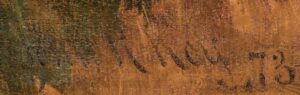
- 1873
-

- 1873
-
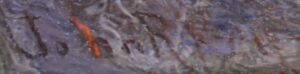
- 1873
-

- 1878
Image Credit
Harris and Ewing, 1914
References
Independent research by the authors
Who Was Who in American Art