Edward Hill was born in England and came to America as a child. He arrived in New York City aboard the Queen of the West with his mother on August 13, 1844. Edward was the younger brother of noted landscape artist Thomas Hill and painted throughout New England, the American West, and Europe. As a teenager, he worked as a furniture decorator in Gardner, MA, alongside his brothers Thomas and Robert Hill. He studied art in Paris, Vienna, Venice and other European cities.
In 1862, and again between 1872 and 1873, Edward moved to San Francisco, CA, and shared a studio with his brother, Thomas, at 15 Ellis Street. Beginning in the mid 1870s, and for fifteen summers, Edward Hill was artist-in-residence at the Profile House in Franconia Notch. In his art studio, he exhibited paintings of the local scenes and sold them directly to hotel guests. Hill was a prolific artist who painted every aspect of White Mountain landscape. Hotel guests purchased his New England paintings and carried them to every corner of America.
In 1879 and 1880, and again in 1891, Hill moved his art studio to Room 18 in the Tilton Opera Block, in Littleton, NH. Local photographer and stereoscopic view publisher, Benjamin W. Kilburn, purchased numerous paintings from Edward Hill during this period. Many of the works acquired by Kilburn are now part of the collection of the Littleton Library and the adjacent Littleton Community Center.
During July of 1892, Hill relocated his studio to the Cruft Block in nearby Bethlehem, NH. In 1893, he moved again, and rented space in the Blanchard Building, in Concord, NH. Hill painted at the Glen House (1884), the Waumbek Hotel (1885), the Flume House (1894), Nashua (at the Odd Fellow’s Building between 1895 to 1899) and in New Boston, NH (between 1899 to 1901). He exhibited at the Boston Art Club, Melrose Art Club, San Francisco Art Association, Utah State Fair, Utah Art Institute, and the Portland Oregon Library.
Hill spent the last years of his life on the West Coast. He maintained a studio in Denver, CO (618 Mack Building), Salt Lake City, UT (317 Templeton Building) and Hood River, OR (above Franz Hardware) where he painted the scenery of the Pacific Northwest. During this time period he also painted in Los Angeles, CA (434 Copp Building), Portland, OR (600 Concord Building), Seaside, OR (Box 311), and Seattle, WA (604 Crary Building). In Seattle, during 1918, he was employed at the local Skinner & Eddy Shipyard, painting the sides of battleships in support of World War I.
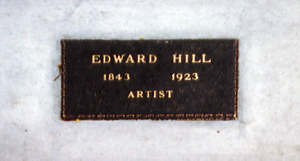
After suffering a stroke earlier in the year, on August 27, 1923, Edward Hill died from a cerebral hemorrhage at Hood River, OR. His funeral was handled by the Hood River Masonic Lodge at the Anderson Chapel and he was buried in an unmarked grave at the Idlewilde Cemetery in Hood River. In 1983, sixty years after Hill’s death, a plaque was placed on Hill’s grave-site which reads: “EDWARD HILL, 1843 1923, ARTIST.” This marker was erected through the generosity of Robert A. Goldberg.
Image of Edward Hill
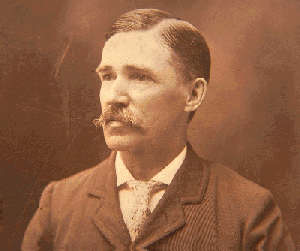
Edward Hill (1843-1923)
Gravestone
Signatures
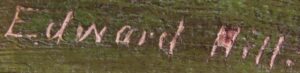
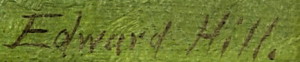
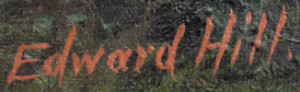
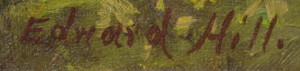

-
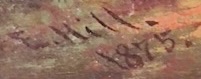
- 1875
-
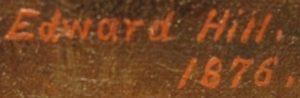
- 1876
-
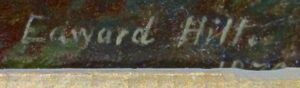
- 1879
-
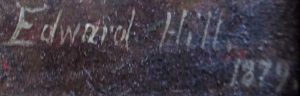
- 1879
-
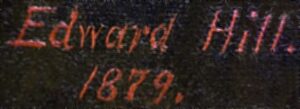
- 1879
-
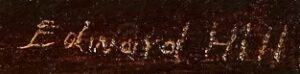
- 1880
-
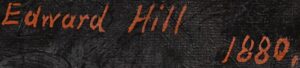
- 1880
-
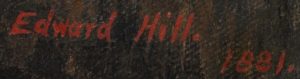
- 1881
-
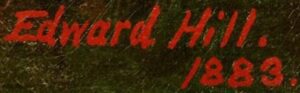
- 1883
-

- 1883
-
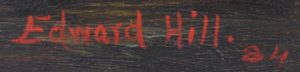
- 1884
-
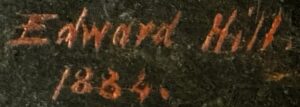
- 1884
-
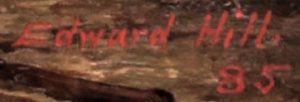
- 1885
-
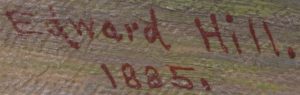
- 1885
-
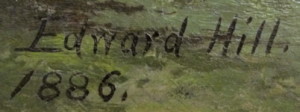
- 1886
-

- 1886
-
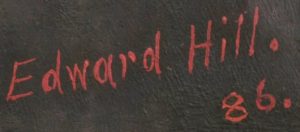
- 1886
-
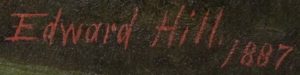
- 1887
-

- 1891
-
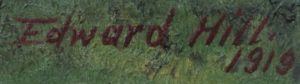
- 1919
-
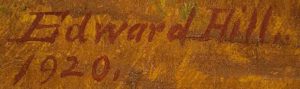
- 1920
References
Independent research by the authors
Independent research by Charles Vogel and Allen Vogel
Nature's Nobleman: Edward Hill and His Art